FairwayPlan does not cost anything to use. No account. No email. No trial period that expires and asks for a credit card. You fill in the wizard, the solver builds your itinerary, and you get a shareable link. That is the whole transaction.
I mention this upfront because it shapes everything else about how the product works, including a particular behaviour of the solver that I did not expect when I built it.
The pricing problem nobody talks about
Most travel booking platforms treat price as a reveal. You browse, you compare, you select, and then somewhere near the end of the process the real cost appears. Resort fees. Seasonal surcharges. Dynamic pricing that shifted between the time you loaded the page and the time you clicked "book." The entire model depends on sunk cost: by the time you see the number, you have invested enough attention that walking away feels like a loss.
Golf trip planning has the same problem. Green fees vary by season, by day of the week, by affiliation status. An NZ Golf affiliate pays one rate. An international visitor pays another. A casual player with no handicap pays a third. Most course websites list one number, usually the cheapest, and leave you to work out which one applies to you.
FairwayPlan shows all of it upfront. When the solver builds your itinerary, every day card shows the green fee for that specific course, on that specific date, for your specific affiliation. The daily total is right there. The trip total is at the bottom. The budget constraint you set in the wizard is honoured, and you can see exactly how it was honoured, which courses the solver chose to fit inside it.
This is possible because the app is free. There is no commission. There is no referral margin to protect. If a $45 twilight round at a regional course fits your budget better than a $180 championship round, the solver will pick it. It has no incentive to do otherwise.
Five regions get all the attention
FairwayPlan covers 16 regions across New Zealand. If you look at the itineraries people generate, five regions dominate: Auckland, Bay of Plenty, Canterbury, Queenstown-Lakes, and Otago. These are the names people know. They have the championship courses, the resort towns, the international flights.
That leaves eleven regions that most users never select.
Hawke's Bay. Manawatu-Whanganui. Taranaki. Waikato. Northland. Southland. Gisborne. West Coast. Nelson-Tasman. Marlborough. Wellington.
Some of these have only a handful of courses in the database. Others have dozens. What they have in common is that nobody thinks of them first when planning a golf trip to New Zealand. They are the background. The bits you drive through on the way to somewhere famous.
The solver does not care about fame
Here is the thing I did not anticipate. When you set a moderate budget, select multiple regions, and give the solver room to work, it frequently picks courses in the eleven. Consistently.
The solver optimises for a weighted combination of course rating, prestige score, weather conditions, drive time between rounds, and budget fit. It does not know which regions are popular. It does not know which courses have marketing budgets or Instagram accounts. It just runs the numbers.
And the numbers often favour a well-rated course in Hawke's Bay over a famous one in Queenstown. The green fee is lower. The weather in the shoulder season can be better. The drive time from the previous day's course is shorter. On the solver's scorecard, these factors add up.
Waikato has courses with genuine character that cost a third of what you would pay in Queenstown-Lakes. Taranaki has mountain-framed fairways and green fees that international visitors find genuinely confusing, in the "is this a mistake?" sense. Manawatu-Whanganui has Manawatu Golf Club, which has hosted more NZ Opens than almost anywhere else in the country. Most people could not point to it on a map.
The honesty box model
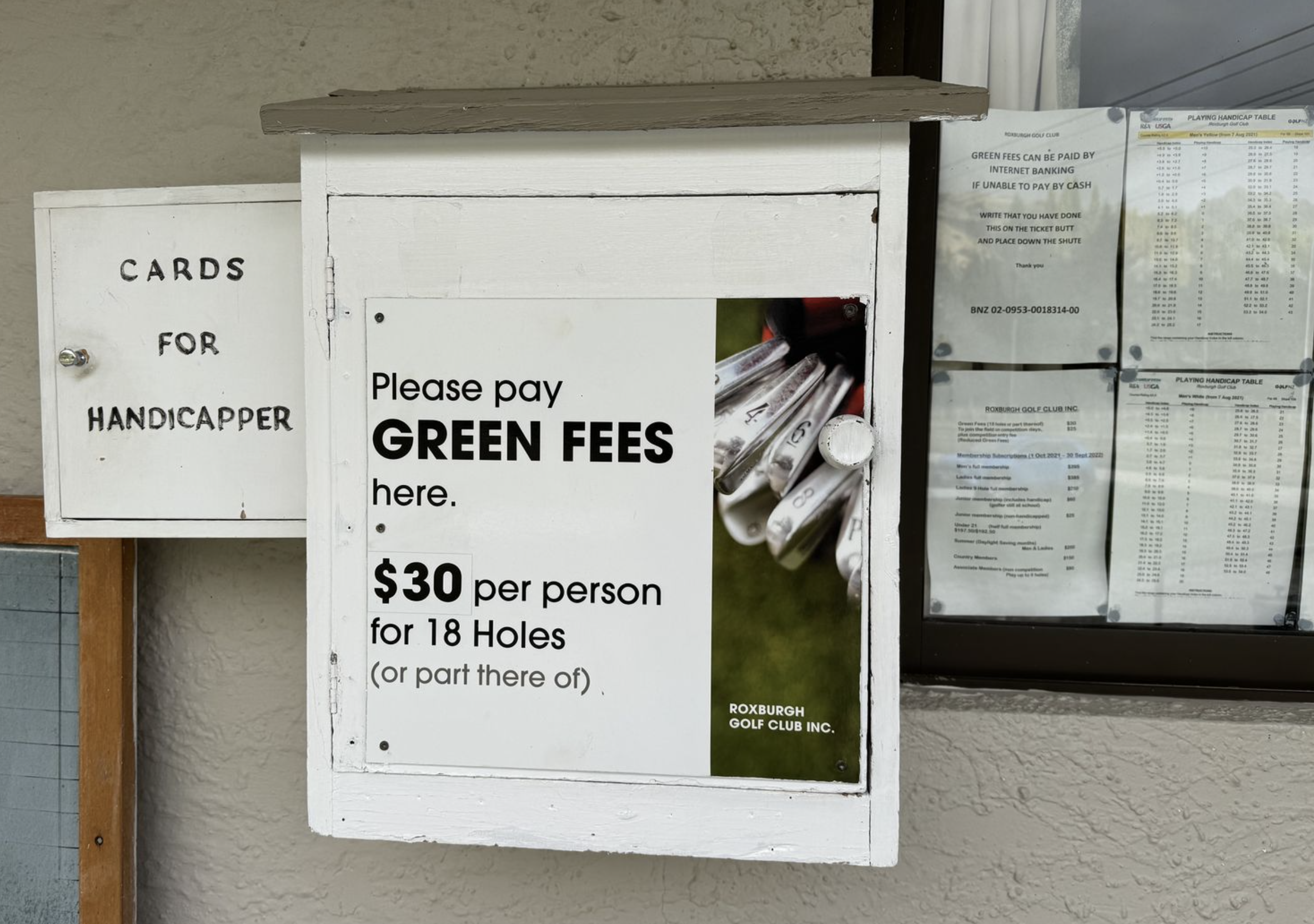
There is a tradition in rural New Zealand golf. You drive up to a small course, there is no clubhouse, there is no pro shop, there is a box nailed to a post with a slot in the top and a sign that says the green fee. You put your money in. You play. Nobody checks.
FairwayPlan works on something like the same principle. The information is all there. The prices are real. The solver's reasoning is transparent. You can see exactly why it chose what it chose. There is no hidden layer trying to steer you toward a more expensive option.
When you remove the incentive to upsell, the recommendations change. They get quieter. They point toward places that are genuinely good value rather than places that pay the highest commission. The solver has no opinion about which course benefits from your visit. It only has an opinion about which course fits your trip.
When you remove the incentive to upsell, the recommendations get quieter. They point toward places that are genuinely good value.
Try adding a region you have never heard of
Next time you use the wizard, add one of the eleven. Pick a region you would never have considered. Taranaki. Southland. Gisborne. Let the solver do its work.
You might get exactly what you expected: a well-known course in a well-known place filling most of your itinerary. Or you might get something else. A course you have never heard of, at a price that seems too low, with a rating that makes you look twice. The kind of place with an honesty box and a view that nobody has put on a brochure.
The solver found it because it was looking at the numbers. You found it because the tool was free and had no reason to hide it from you.
A $45 twilight round at a regional course might be exactly what your trip needs. A free tool has no reason to steer you elsewhere.